
Top 10 Omnichannel Retail Trends Shaping Commerce in 2026


Walk into any retail store today, and you'll see customers doing something that would've seemed odd five years ago: they're shopping with their phones out. Scanning barcodes. Checking reviews. Comparing prices. Looking up stock at other locations. The phone isn't replacing the store—it's becoming part of it.
That's omnichannel in 2026. Not a marketing term. Not a technology project. It's how shopping actually works now.
A customer spots a jacket on Instagram, clicks through to your site, adds it to cart but doesn't buy. Two hours later, they're near your store, get a notification that it's in stock, walk in to try it on, decide they want a different size, and the sales associate orders it from another location for next-day delivery. They pay on their phone, earn loyalty points, and leave. The jacket arrives the next morning. They keep it.
That entire journey crossed six different systems. And to the customer, it felt like one smooth experience.
46% of retail executives say omnichannel is their top priority—ahead of loyalty programs, private labels, and new stores.
The gap between retailers who've figured this out and those who haven't is getting wider. According to Deloitte, nearly half of retail executives are prioritizing omnichannel above everything else. They're putting real money behind it too—97% plan to increase omnichannel technology spending this year.
But here's what most won't tell you: only 15% of retailers think they're actually using their omnichannel systems well. The rest are stuck with duct-taped solutions—an e-commerce platform that doesn't talk to the POS system, inventory data that updates overnight instead of in real time, loyalty points that live in one system while purchase history lives in another.
Customers notice these gaps immediately. They check your website, see a product in stock, drive to the store, and find out it's not actually there. They buy something online, try to return it in-store, and get told "that's a different system." Small friction points that add up to shopping somewhere else next time.
This article breaks down what's actually working in 2026. Not vendor pitches or theoretical frameworks—real implementations from retailers who've connected their systems and are seeing results. We talked to people running these operations, looked at the data, and pulled out the trends that matter.
Here's what we're covering:
- How retailers are using AI to predict what'll sell before customers even search for it
- Why Google search results look completely different now (and what that means for your products)
- The evolution beyond "buy online, pick up in store" to fulfillment from anywhere
- How loyalty programs stopped being about points and became retention engines
- What happens when your mobile app becomes more important than your website
- Why chatbots finally stopped being useless (and what changed)
- The surprising comeback of physical stores—as entertainment, not just transactions
- How to use customer data without being creepy about it
- Why your stores are becoming mini-warehouses (whether you planned for it or not)
- The payment options customers now expect across every channel

Customers move fluidly between channels. Your systems need to keep up.
1. AI-Powered Inventory Management Across All Channels
What's happening
Retailers are using AI to predict what customers will buy, when, and where. Instead of guessing, they're letting machine learning analyze sales patterns, weather, local events, social media trends, and browsing behavior to forecast demand down to the SKU and location level.
This isn't just "we think this will sell." It's "we know this size, in this color, at this store, will run out by Thursday unless we move 12 units from the distribution center."
Why it matters
Inventory problems cost retailers billions. Overstocking ties up cash in products that don't move. Stockouts lose sales and frustrate customers who might not come back. AI cuts both problems.
Research shows that companies using AI-powered inventory management reduce costs by 10-15% while improving efficiency by 20-25%. That's real money going straight to the bottom line.
Real example: Warby Parker uses AI to predict which frames, sizes, and colors each store needs based on local demand patterns. The system analyzes everything from past sales to foot traffic to weather forecasts. Result: they've improved stock accuracy and reduced situations where customers walk into a store only to find their preferred style out of stock.
How to implement it
You don't need to build this from scratch. Here's a practical path:
-
Start with forecasting tools: Many Shopify-compatible apps offer AI-powered demand planning. They integrate with your existing systems and start spotting patterns immediately.
-
Connect your channels: Sync your POS, e-commerce platform, and fulfillment systems in the cloud. When inventory updates one place, it updates everywhere.
-
Automate the obvious stuff: Set rules for reorders, low-stock alerts, and returns. Let AI handle the repetitive decisions so your team can focus on exceptions.
-
Review the data weekly: Look for patterns you wouldn't have caught manually. Slow movers. Sudden spikes in specific regions. Seasonal shifts happening earlier than expected.
2. AI-Driven Product Discovery (And Why Google Search Looks Different Now)
What's happening
Search results look fundamentally different in 2026. When someone searches for "best running shoes for plantar fasciitis," they're not getting 10 blue links anymore. They're getting an AI-generated answer at the top, pulling information from multiple sources, with shopping options built in.
Google calls this a "profound shift." In 2024, 49% of shoppers started their journey on a search engine. That hasn't changed. What they see when they search has changed completely.
Why it matters
If your products aren't structured for AI to understand and recommend them, you're invisible. Traditional SEO still works, but it's not enough. You need to make your product data AI-readable.
This affects product discovery across every channel—not just Google. Amazon, social platforms, and even in-store kiosks are using AI to surface products based on natural language queries instead of exact keyword matches.
Real example: When you search "comfortable office chair for back pain" on Google, you now see AI-generated summaries that compare features, explain why certain chairs work better for back support, and suggest products from different retailers. The retailers whose product data is cleanest and most detailed get featured.
How to optimize for it
Three things AI needs from your product pages:
-
Structured product data: Use schema markup. Be specific with attributes—material, dimensions, use cases, compatible products. AI can't guess; it needs explicit data.
-
Detailed user reviews: Long, descriptive reviews give AI context about how products perform in real life. A review saying "great chair" doesn't help. One saying "supports lower back well during 8-hour workdays, adjustable armrests fit under desk" does.
-
Authority signals: Expert reviews, third-party validation, media mentions. AI trusts sources that other trusted sources reference. Get featured in industry publications. Get your products reviewed by credible voices in your space.
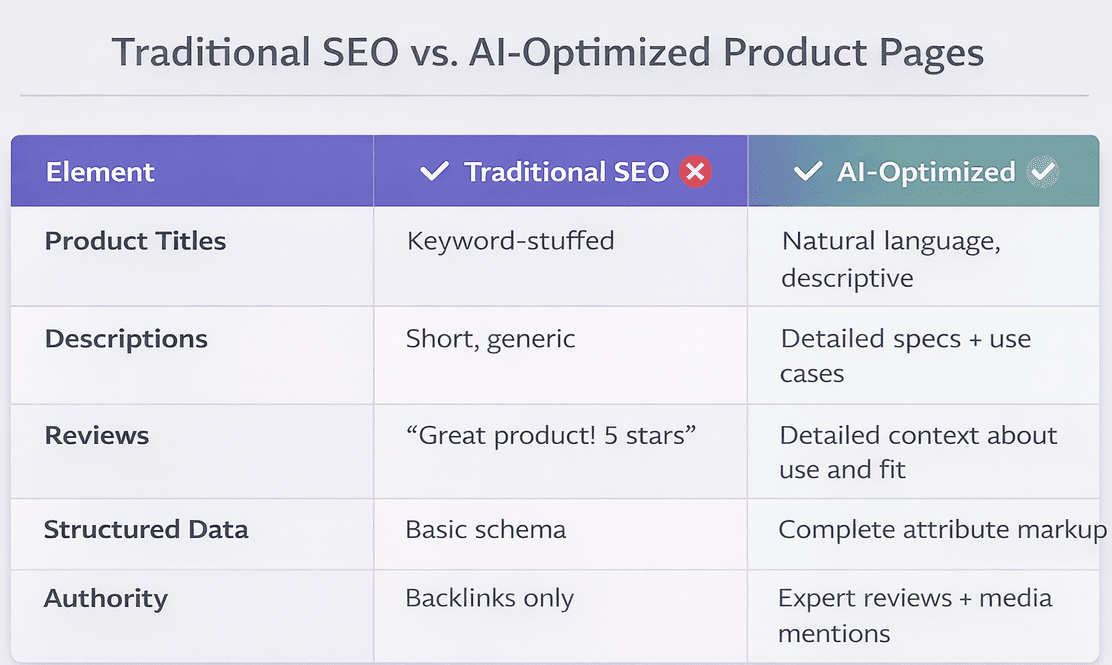
The difference is clear: AI needs context, not just keywords.
3. Buy Online, Fulfill from Anywhere (Not Just Pick Up In Store)
What's happening
BOPIS (Buy Online, Pick Up In Store) used to be the innovation. Now it's expected. What's next: Buy Online, Fulfill from Wherever Makes Sense.
Customers don't care where their order comes from. They care about speed and convenience. So retailers are getting smarter about fulfillment. An online order might ship from a distribution center, a store, or even directly from a vendor—whichever option gets it to the customer fastest.
Why it matters
Speed wins. Amazon trained customers to expect fast delivery. Now everyone else has to keep up. The retailers who can fulfill same-day or next-day from the closest possible location have a massive advantage.
Plus, using stores as mini-warehouses reduces shipping distances, cuts costs, and moves inventory that might otherwise sit on shelves.
Real example: Dick's Sporting Goods accelerated their buy-online-pickup-curbside service during COVID and never looked back. Now, if you need equipment urgently—say, cleats for a game tonight—you can order online, and they'll have it ready at the closest store in under an hour. That used to be impossible.
How to make it work
This requires tight integration:
- Real-time inventory visibility: Your website needs to know exactly what's in every store, not just what's in your warehouse.
- Smart routing logic: Your order management system should automatically choose the best fulfillment location based on customer location, inventory levels, and delivery speed.
- Clear communication: Tell customers where their order is coming from and when it'll arrive. No surprises.
- Easy returns: Let them return online orders in-store and vice versa. No friction.
4. Loyalty Programs That Actually Drive Behavior (Not Just Points)
What's happening
Loyalty programs are evolving from "collect points, get discounts" to "we know what you want before you do." The best programs now influence every touchpoint—what you see on the website, which offers show up in your email, how store associates interact with you.
In 2026, loyalty isn't a program. It's the operating model for retention.
Why it matters
Starbucks proved this works. Their AI-powered loyalty program analyzes purchase patterns and sends personalized offers. If you always buy a latte on Monday mornings, they'll nudge you with a Monday morning deal. Result: members visit 5 times more often than non-members.
It's not about giving discounts to everyone. It's about giving the right incentive to the right person at the right time.
Real example: Sephora's Beauty Insider program doesn't just give you points. It gives you early access to products based on your purchase history, personalized product recommendations, and exclusive experiences (like beauty classes). Your loyalty tier affects what you see when you browse, which emails you get, and how you're treated in-store.
How to build one that works
- Make status meaningful: Your loyalty tiers should unlock real benefits, not just more points. Early access. Better customer service. Exclusive products.
- Personalize across channels: If someone's a VIP online, they should be a VIP in-store. Train your team to recognize loyalty members and treat them accordingly.
- Use data to predict behavior: Look at replenishment cycles. If someone buys skincare every 60 days, remind them at day 55 with a personalized offer.
- Test and iterate: Run A/B tests on offers. See what drives repeat purchases. Double down on what works.
5. Mobile-First Shopping (Because Your Phone Is Your Store)
What's happening
Mobile isn't just for browsing anymore. It's where people research, compare prices, check stock, scan QR codes in-store, complete purchases, and manage returns. Nearly 70% of shoppers pull out their phones in-store to check if competitors nearby offer better deals.
The phone is the glue connecting online and offline. If your mobile experience isn't good, your omnichannel strategy falls apart.
Why it matters
Mobile commerce is growing faster than any other channel. But it's not just about selling through apps. It's about using mobile to enhance every part of the shopping journey.
Customers want to scan a barcode in your store and see reviews. They want to check if another location has their size. They want to pull up their loyalty account and show it to a cashier. If your systems can't handle that, you're losing sales.
Real example: Walmart's mobile app lets you scan items as you shop, check prices, locate products in the store, and pay—all from your phone. They've also integrated QR codes in stores that link to products only available online, bridging the gap between physical and digital inventory.
How to get it right
- Speed matters: Mobile pages need to load in under 2 seconds. Any slower and you're losing people.
- Make checkout simple: One-click checkout. Apple Pay. Google Pay. Don't make people type their credit card info on a tiny keyboard.
- Connect in-store and mobile: QR codes on shelf tags. Barcode scanning for reviews. Mobile checkout so people can skip the line.
- Push notifications that help: "Your item is back in stock." "Your order is ready for pickup." "There's a sale on something you looked at." Not spam. Useful alerts.
6. Conversational Commerce (Chatbots That Don't Suck)
What's happening
Chatbots used to be useless. You'd ask a question, get a canned response, and then have to find a human anyway. In 2026, AI-powered shopping assistants actually understand what you're asking and can help you find products, track orders, and complete purchases.
This isn't just text chat. It's voice assistants, messaging apps, and even in-store kiosks powered by conversational AI.
Why it matters
Customers want instant answers. They don't want to dig through FAQs or wait 24 hours for an email reply. Conversational AI gives them help the moment they need it, in the channel they're already using.
And it works 24/7. No staffing issues. No hold times.
Real example: Home Depot's AI assistant helps customers online with project planning. You can ask, "What do I need to install a new faucet?" and it'll suggest products, show installation videos, and build a shopping list. Then it helps you check stock at your local store and offers delivery options.
How to implement it without annoying people
- Train it on your actual products: Generic chatbots don't work. Train your AI on your catalog, common questions, and return policies.
- Make it easy to reach a human: If the bot can't help, don't trap people. Let them escalate to a real person immediately.
- Use it for simple stuff first: Order tracking. Product specs. Store hours. Master the basics before trying to handle complex customer service issues.
- Test it constantly: See where it fails. Fix those gaps. Repeat.
7. Physical Stores as Experience Centers (Not Just Transactions)
What's happening
Stores aren't dying. They're changing. Retailers are redesigning stores to offer things you can't get online: try before you buy, expert advice, community events, and immersive experiences.
The goal isn't just to make a sale. It's to create a reason to visit.
Why it matters
Six in ten shoppers say they prefer in-person shopping because they enjoy it—not just for convenience, but for the experience. Physical stores satisfy things digital can't: touching products, getting instant help, and the social aspect of shopping.
Plus, stores serve as fulfillment hubs, return centers, and brand touchpoints. The retailers winning in 2026 understand that stores are part of a larger system, not standalone locations.
Real example: Dick's Sporting Goods' "House of Sport" concept features rock climbing walls, batting cages, and golf simulators. You can test equipment before buying it. They've also added digital displays that let you browse products not stocked in-store and order them on the spot. It's retail as entertainment.
How to rethink your stores
- Host events: Workshops, product demos, community gatherings. Give people a reason to show up.
- Make associates experts: Train your team deeply on products. Customers can Google basic specs. They come to stores for advice you can't get online.
- Add digital touchpoints: Kiosks where customers can browse your full catalog. Tablets for associates to check stock at other locations. QR codes for product details.
- Use stores for fulfillment: Same-day pickup. Returns. Exchanges. Make it easy to move between online and offline.
8. Privacy-First Data Strategies (Using Data Without Being Creepy)
What's happening
Regulations are tightening. Third-party cookies are dying. Customers care more about privacy. Retailers have to shift from tracking people across the internet to building direct relationships based on data customers willingly share.
This is forcing brands to focus on first-party data—information customers give you directly, like email signups, purchase history, and loyalty program activity.
Why it matters
If you've been relying on third-party data to target ads, that's going away. The retailers who build their own customer databases now will have a massive advantage in a few years.
Plus, customers trust brands that are transparent about data usage. If you're upfront about what data you collect and how you use it, people are more willing to share.
Real example: Apple's privacy changes in iOS made it harder for retailers to track users across apps. Brands like Nike responded by investing heavily in their own apps and loyalty programs, collecting data directly from customers instead of relying on ad networks.
How to build a first-party data strategy
- Offer value in exchange for data: Exclusive deals. Early access. Personalized recommendations. Give people a reason to sign up.
- Be transparent: Tell customers what data you collect and why. Let them control their preferences.
- Centralize your data: Don't let customer data live in silos. Unify it so you can see the full picture across channels.
- Use it to personalize, not creep people out: "You might like this based on your last purchase" feels helpful. "We know you browsed this at 2 AM last Tuesday" feels invasive.
9. Unified Payments Across Every Channel
What's happening
Payment options are multiplying. Buy now, pay later. Digital wallets. Cryptocurrency (in some cases). Customers expect to pay however they want, wherever they are—online, in-store, or through an app.
But here's the catch: if a payment method works on your website but not in your stores, that's friction. And friction kills sales.
Why it matters
Payments are part of the customer experience. A smooth checkout reinforces trust. A clunky one makes people abandon their cart.
Plus, offering flexible payment options increases conversion. Buy now, pay later options can boost cart values by 20-30% because customers are more willing to spend when they can split payments.
Real example: Five Guys emphasizes consistent payment options across all touchpoints. If you can pay with Apple Pay on their app, you can pay with it in-store. Seems obvious, but plenty of retailers still have disconnected payment systems.
How to unify payments
- Use a unified payment platform: Systems like Stripe, Square, or PayPal can handle payments across web, mobile, and in-store from one integration.
- Offer popular options: Credit cards, debit cards, digital wallets (Apple Pay, Google Pay), and buy now, pay later (Afterpay, Klarna). Cover the basics.
- Make checkout fast: Save payment info for returning customers. Enable one-click payments. Don't make people re-enter their card every time.
- Test for security: Customers won't buy if they don't trust your checkout. Use trusted payment processors and display security badges.
10. Real-Time Personalization (Not Batch Processing)
What's happening
Old-school personalization worked like this: collect data, analyze it overnight, send emails the next day based on what people did yesterday. That's too slow now.
Real-time personalization means the website, app, or in-store experience changes based on what a customer is doing right now. They're browsing winter coats? Show them coats. They abandoned a cart? Nudge them immediately. They're a VIP? Reflect that the moment they log in.
Why it matters
Customers don't wait. If you're still using yesterday's data to make today's decisions, you're behind. Real-time personalization increases conversion rates by catching people when their intent is highest.
McKinsey found that personalization can boost revenue by 6-10%. But that only works if you're fast enough to act on signals while they're fresh.
Real example: Amazon's homepage changes in real time based on what you've browsed, searched, and bought. Not just today—right now. Click on camping gear, and suddenly you're seeing tents, sleeping bags, and portable stoves. That's real-time personalization driving 35% of their revenue.
How to implement it
- Invest in a customer data platform (CDP): You need a system that unifies data from every channel and updates in real time. Tools like Segment, Tealium, or Adobe CDP make this possible.
- Use AI for decisioning: Set up rules for what to show based on behavior. "If browsing category X, recommend Y." Let AI learn what works.
- Personalize email and SMS triggers: Abandoned cart emails should go out within an hour, not the next day. Back-in-stock alerts should fire the moment inventory updates.
- Test everything: Run A/B tests on personalization strategies. See what drives clicks, conversions, and repeat purchases. Refine constantly.
Pulling It All Together: What Omnichannel Actually Looks Like in 2026
Here's the thing about omnichannel: it's not a single project. It's not something you "finish." It's a way of operating.
The retailers winning right now have stopped thinking about online and offline as separate things. They've built systems where:
- Inventory is one pool, not separate silos
- Customer data flows across every touchpoint
- Fulfillment happens from wherever makes sense
- Loyalty status follows customers everywhere
- Payment options are consistent across channels
- Personalization updates in real time, not overnight
That's not easy to build. It requires tight integration between systems that often weren't designed to work together. It requires training teams to think differently. And it requires constant iteration as technology and customer expectations evolve.
But it's worth it. The data is clear: retailers with mature omnichannel capabilities are growing faster, retaining customers longer, and operating more efficiently than those still treating channels as separate entities.
Key Takeaway: Omnichannel isn't about doing everything everywhere. It's about doing the right things in the right places and making sure they all connect. Start with the channels that matter most to your customers. Nail the integration. Then expand.

These six elements form the foundation of every successful omnichannel retail operation in 2026.
How to Get Started (Without Overwhelming Your Team)
If you're reading this and thinking, "This sounds great, but where do we even begin?"—here's a practical roadmap.
Phase 1: Audit What You Have
- Map your current systems (e-commerce platform, POS, inventory management, CRM, loyalty program)
- Identify where data doesn't sync (customers can't see in-store inventory online, loyalty points don't transfer, etc.)
- Talk to customers and store teams. Ask where they feel friction.
Phase 2: Fix the Basics
- Get inventory visibility across all channels
- Enable buy online, pick up in store (if you haven't already)
- Make sure customers can return online orders in-store and vice versa
- Sync loyalty accounts so status shows up everywhere
Phase 3: Layer in Intelligence
- Add AI-powered inventory forecasting
- Implement personalization on your website and app
- Set up conversational AI for common customer service questions
- Use data to optimize fulfillment routing
Phase 4: Optimize and Expand
- Test new fulfillment options (same-day delivery, ship from store)
- Expand personalization to email, SMS, and in-store
- Add advanced payment options (buy now, pay later, digital wallets)
- Use AI to predict customer needs and proactively suggest products
The key is not trying to do everything at once. Pick the integrations that will have the biggest impact on your business and start there.

The Bottom Line
Omnichannel retail in 2026 isn't about having every possible feature. It's about making the features you have work together.
Customers don't see channels. They see your brand. If their experience is disjointed—if inventory data is wrong, if loyalty points don't sync, if they can't return an online order in-store—they notice. And they leave.
The retailers who get this right are the ones treating omnichannel as an operating system, not a marketing campaign. They're connecting systems, training teams, and obsessing over the moments where online and offline meet.
It's not easy. But the gap between retailers who've figured this out and those who haven't is widening. In 2026, you're either building a connected experience or you're losing ground to someone who is.
Thinking about how these omnichannel trends apply to your business?
If you’re trying to turn 2026’s omnichannel trends into real systems—connected inventory, smarter fulfillment, unified data, and real-time personalization—we can help. Coderapper works with retail teams to design and integrate omnichannel architectures that scale in the real world.
FAQs
Related Articles


Top 10 Omnichannel Retail Trends Shaping Commerce in 2025


Omnichannel Order Management in 2025: How Modern Retailers Orchestrate Inventory, Fulfillment, and CX


What Is Omnichannel Experience? CX Pillars and 2025 Trends for Enterprise Brands


