Shopify's Universal Commerce Protocol (UCP): How AI Shopping Just Changed Everything


Remember when adding items to a shopping cart felt revolutionary? Well, that just became old news.
Last week, Shopify and Google announced something that's going to change how we shop online: the Universal Commerce Protocol (UCP). Think of it as a universal translator that lets AI assistants buy things from any online store on your behalf.
Here's the wild part: You can now tell ChatGPT, Google's Gemini, or Microsoft Copilot "I need running shoes" and actually buy them without ever leaving the chat. The AI finds the product, checks your saved payment info, and completes the purchase—all in one conversation.
If you run an online store, this is huge. Your products can now show up wherever people are already talking to AI.
The Problem UCP Solves
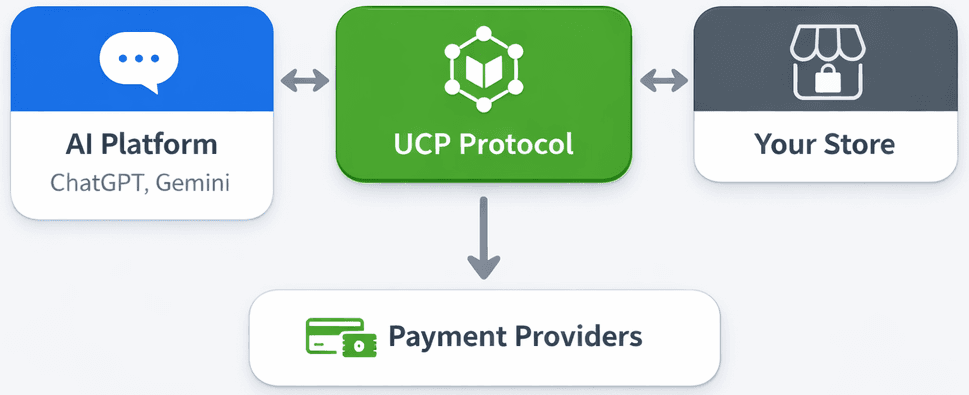
You're chatting with an AI about gear for an upcoming hiking trip. The AI finds perfect trail shoes, knows your size, even has your payment info—but can't finish the purchase because there's no standard way for AI tools to talk to online stores.
Before UCP, every AI platform needed its own custom connection to every store. Want to sell on ChatGPT? Build a custom setup. Want to sell on Google Gemini? Build another one. It was a mess.
UCP creates a common language between AI platforms, merchants, payment providers, and digital wallets. Set things up once and sell everywhere AI conversations happen.
Why Google and Shopify Built This Together

Google brings:
- 8+ billion searches daily
- Gemini AI assistant
- Google Pay infrastructure
- Agent Payments Protocol experience
Shopify brings:
- 20+ years running online stores
- Millions of active merchants
- Billions of transactions processed
- Real-world commerce expertise
The result? A system that handles the messy reality of real online businesses—from discount codes to subscription boxes to complex shipping.
How UCP Works
The Handshake
Think of UCP like two people meeting and figuring out what language they both speak. Every store puts a simple file on their website that says "Here's what I can do":
My store supports:
- Checkout
- Shipping options
- Discount codes
- Subscriptions
- Gift cards
Payment methods I accept:
- Google Pay
- Shop Pay
- PayPal
AI assistants read this and automatically know how to work with that store. No phone calls, no meetings, no custom coding needed.
The Shopping Process
Here's what happens behind the scenes when someone buys through AI:
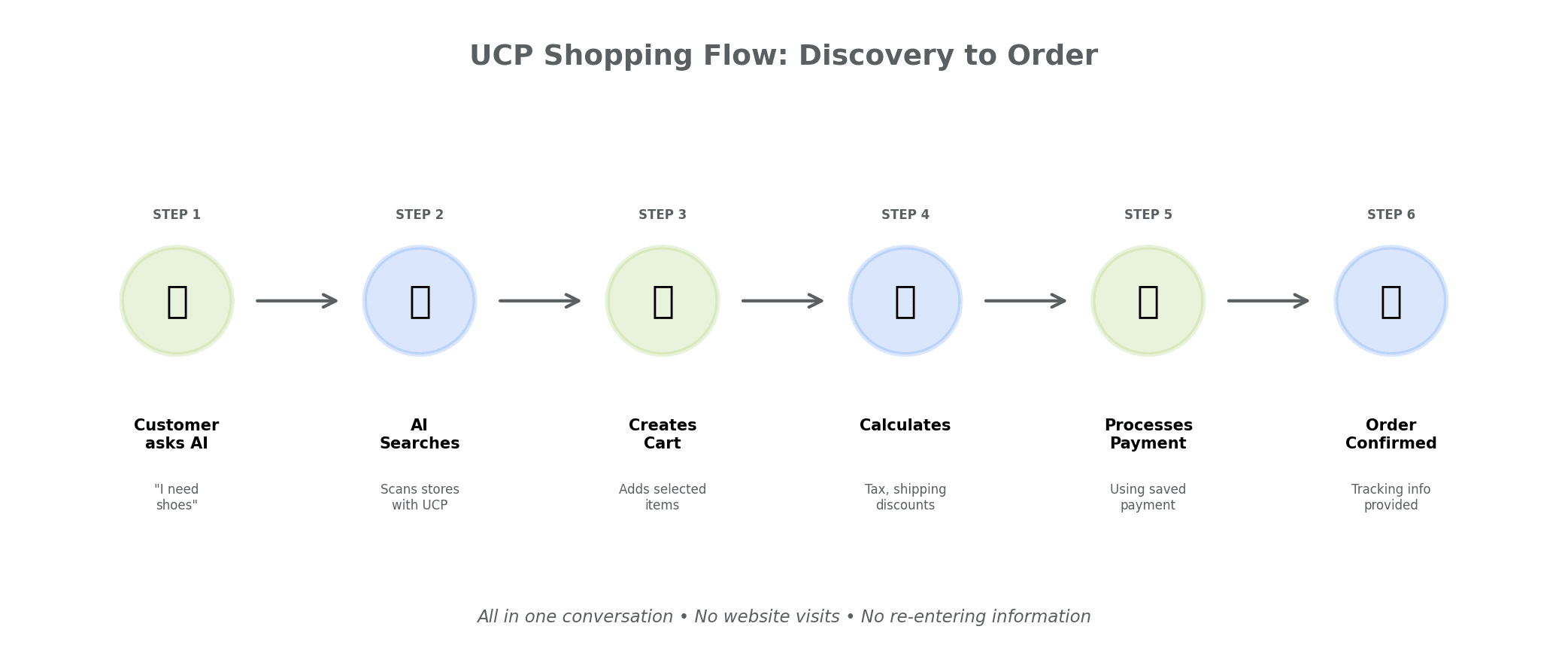
- Step 1: Discovery - Customer asks "I need waterproof hiking boots"
- Step 2: AI Search - Scans stores with UCP to find matches
- Step 3: Cart Creation - Adds selected items to shopping cart
- Step 4: Calculate Everything - Taxes, shipping costs, discounts applied
- Step 5: Payment - Processes using saved payment info
- Step 6: Confirmation - Order confirmed, tracking info provided
All of this happens in one conversation. No opening new tabs, no re-entering information, no getting distracted and abandoning the cart.
When Things Get Complex
Sometimes buying online isn't simple. Real-world examples:
- Furniture: Need to pick specific delivery date and time window
- Custom laptops: Choosing specs, RAM, storage, warranty options
- Subscription boxes: Selecting frequency, dietary restrictions, preferences
- B2B orders: Adding PO numbers, approval workflows, split shipping
For these situations, UCP includes something called "Embedded Commerce Protocol" (ECP). This shows your actual checkout page inside the AI chat. Customers get the full experience—custom options, your branding, all your business logic—without leaving the conversation.
This is huge because it means complex businesses can use UCP, not just simple retail stores.
Payment Flexibility
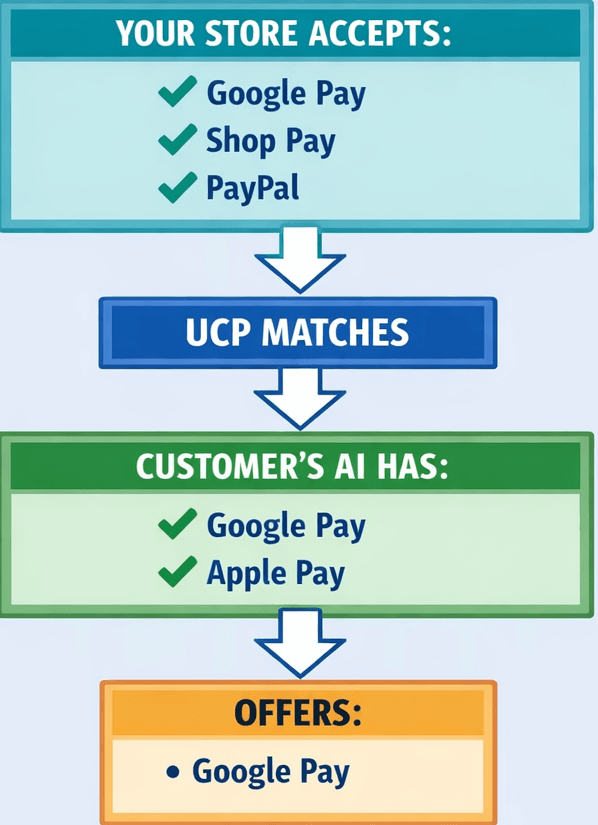
UCP doesn't force specific payment methods. Each payment company publishes their own "handler" that says "here's how to use our service."
How it works:
- Your store lists accepted payments: Google Pay, Shop Pay, PayPal
- Customer's AI has: Google Pay, Apple Pay
- UCP matches: Google Pay (works for both)
- Customer pays: Using their saved Google Pay info
Want to add a new payment option? Just add it to your list. The next time someone shops, the AI will see it as available. No waiting for UCP to update, no complex integration.
This flexibility means regional payment methods work too. If you sell in Germany and accept SEPA transfers, customers with AI that supports it can use it. If you're in India accepting UPI payments, same thing.
UCP vs. ACP: What's the Difference?
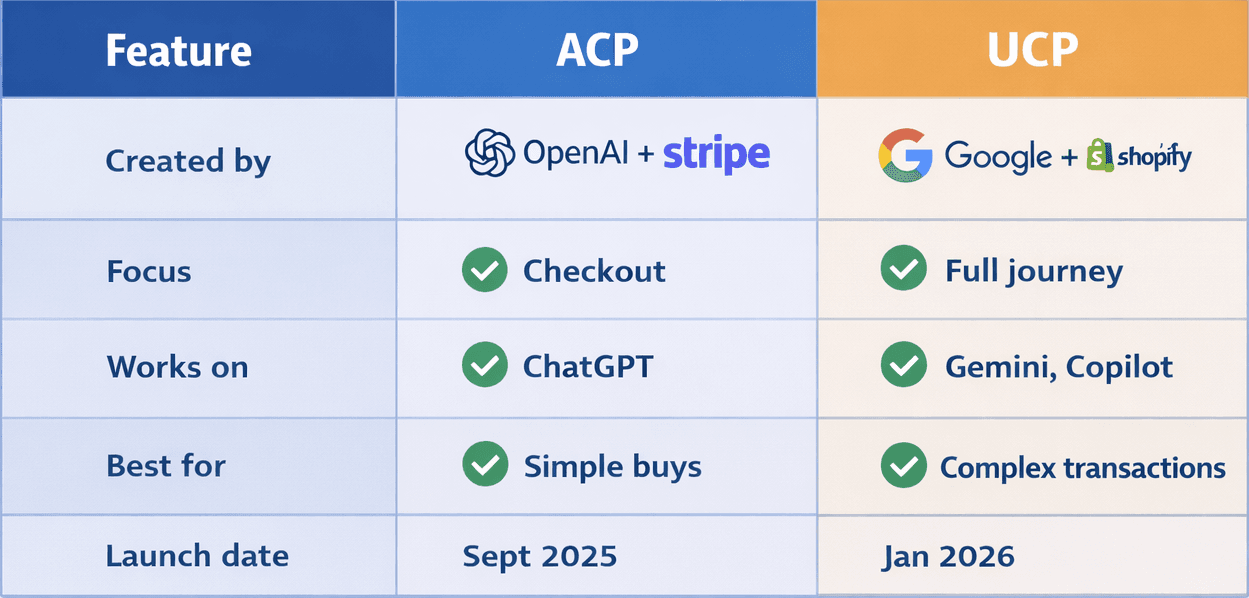
Three months before UCP, OpenAI and Stripe launched ACP (powers ChatGPT shopping).
Reality: You'll need both. Walmart uses ACP for ChatGPT and UCP for Gemini. Result: 20% of website traffic now comes from AI assistants.
What This Means for Your Business
Small Online Stores (Under $5M/year)
What you gain: Access to billions of potential customers without building separate connections to each AI platform. One integration reaches ChatGPT users, Google Gemini users, Microsoft Copilot users, and future platforms.
Quick start guide:
- Turn on UCP in Shopify → Agentic Storefronts
- Make sure product descriptions are clear and complete
- Test buying something through Google AI Mode yourself
- Track which sales come from AI platforms
- Monitor customer return behavior
Watch out for: Your products appear next to competitors in AI results. It's like Amazon—great for discovery, but you need a strategy to build loyalty. Focus on turning first-time AI buyers into repeat customers who come directly to your website next time.
Real example: A small activewear brand enabled UCP and got 15% of new customer acquisition through Gemini within 30 days, but only 22% of those customers returned. They added a follow-up email sequence and increased repeat purchases to 41%.
Stores with Physical Locations
What you gain: Let customers buy online through AI and pick up in your store. Check in-store inventory through AI conversations. Connect your online and offline worlds seamlessly.
Quick start guide:
- Set up UCP with "buy online, pick up in store" options
- Connect your loyalty program so AI knows about customer points and preferences
- Enable split shipping (urgent items ship, others available for pickup)
- Train in-store staff on handling AI-initiated orders
Watch out for: Make sure your inventory system is accurate. If AI tells someone an item is available for pickup but it's not actually in stock, you've created a terrible experience. Sync your systems in real-time.
B2B Sellers
What you gain: Company purchasing agents (both human and AI) can buy from you using approved vendors and payment terms. No more back-and-forth emails for routine reorders.
Quick start guide:
- Set up UCP with custom payment terms (Net-30, Net-60)
- Configure approval workflows for orders over certain amounts
- Connect to your existing B2B pricing structure
- Set up account-specific catalogs
Watch out for: B2B is about relationships. Use AI for convenience on routine purchases, not as a replacement for the personal touch that builds trust. Your biggest accounts still need account managers.
For Shopify Stores (30 minutes - 2 hours)
- Log into Shopify admin
- Go to: Settings → Agentic Storefronts
- Enable Google Gemini and Microsoft Copilot
- Choose products to make available
- Test with Google AI Mode
For Other Platforms (2-8 weeks)
- Set up store profile
- Pick connection method (REST, GraphQL)
- Add core features (checkout, catalog, orders)
- Connect payment methods
- Test and go live
Resources: ucp.dev | Google integration guide
Things to Watch Out For
1. Your Products Next to Competitors
The situation: When someone asks AI for "running shoes," your products show up alongside Nike, Adidas, New Balance, and dozens of others. The AI decides how to present them, what order they appear, and which details to highlight.
Real example: Someone searches Google Gemini for "eco-friendly luggage under $300." Monos, Away, and Samsonite all appear. Which one gets the sale depends entirely on how the AI describes each brand, not on your ad spend or SEO.
What to do about it:
- Write product descriptions that clearly explain what makes you different
- Include specific details AI can use: "recycled ocean plastic," "lifetime warranty," "fits 7 days of clothes"
- Use high-quality product photos from multiple angles
- Build a follow-up strategy: email, SMS, loyalty program to bring customers back
- Track: Are AI customers becoming repeat buyers or one-time purchases?
The mindset shift: Treat AI like Amazon in its early days. Great for discovery and reaching new customers. Terrible if it becomes your only sales channel. Use it to meet customers, then build direct relationships.
2. Platform Fees Eat Your Margins
The situation: AI platforms will likely charge commission, probably 10-15% similar to other marketplaces. This significantly impacts your profitability.
The math:
- Your current profit margin: 20%
- Platform takes: 12%
- Your new margin: 8%
- Add marketing costs to acquire that customer
- Real profit: Maybe 3-5%
What to do about it:
- Calculate your actual unit economics before going all-in
- Use AI platforms primarily for customer acquisition, not all sales
- Make sure first-time buyers return to your website for repeat purchases
- Consider slightly higher pricing for AI channel to maintain margins
- Track customer lifetime value by acquisition channel
- If AI customers never return directly, you're building the platform's business, not yours
The calculation: If an AI-acquired customer is worth $150 over their lifetime and it cost you $15 in platform fees to acquire them, that might work. If they only ever buy once and you paid $18 in fees on a $120 order with 20% margins, you lost money.
3. Less Control Over Your Brand Story
The situation: You can't control how AI describes your products or how they're presented alongside competitors. Your carefully crafted brand message might become "similar to [competitor] but cheaper."
What to do about it:
- Keep investing in your own website, content, and brand building
- Use email and SMS to tell your brand story directly
- Don't become dependent on AI platforms for all sales
- Remember the Amazon lesson: Brands that became dependent lost pricing power and differentiation
- Build communities around your brand (Discord, Facebook groups, email newsletters)
The long game: In 5 years, will customers know your brand or just remember "that thing the AI recommended"? Work backwards from that future.
4. Data Asymmetry Grows
The situation: AI platforms see buying patterns across all merchants. You only see your own data. Over time, they know more about your customers and market than you do.
This leads to:
- Platforms can predict trends you can't see
- They know which products are likely to succeed
- They might launch competing private label products
- You're flying blind while they have radar
What to do about it:
- Join merchant coalitions that share anonymized insights
- Ask platforms for aggregated market data (not just your store stats)
- Build direct customer relationships for first-party data
- Survey your customers about why they bought
- Track everything: traffic sources, conversion rates, return customers
- Invest in your own data analytics capabilities
Your competitive advantage: Direct customer relationships give you data platforms can't see—why customers chose you, what problem they're solving, how they use your products. That's valuable.
What's Coming in 2026
Q1: Google AI Mode launches, Microsoft Copilot expands
Q2: PayPal support, multi-store checkouts
Q3: Voice shopping, international expansion
Q4: B2B support, service businesses
Early movers win. Think Instagram for business in 2014 vs. 2024—same platform, wildly different results.
Optimizing for AI Discovery
Traditional SEO focused on Google rankings. AI shopping needs clarity over keywords.
Checklist:
✓ Clear, natural descriptions
✓ Complete details (size, material, use)
✓ High-quality images
✓ Customer reviews
✓ Fast website
✓ Real-time inventory
Before: "Women's running shoes | Buy ladies athletic footwear"
After: "Lightweight running shoes for women with high arches. Cushioned sole reduces knee impact. Sizes 5-12. Machine washable."
The second helps AI understand what makes your product special and who it's for.
The Bottom Line
If you're not exploring UCP in early 2026, you're betting AI shopping won't matter.
The evidence:
- ChatGPT: 100M users in 2 months
- 45% of US shoppers tried AI shopping
- Walmart's AI traffic: +20% in 6 months
- Google: 8B+ daily searches
When shopping decisions happen in AI conversations, absent stores don't exist.
Looking Ahead
UCP isn't just about today's AI shopping. It's the foundation for software buying on our behalf:
Coming soon: Smart fridges reordering groceries, business software auto-ordering supplies, AI managing subscriptions, your car buying wiper fluid when nearby.
Shopify and Google chose openness over closed systems. That matters. It means shopping could evolve like the web—open standards, anyone can participate.
Or maybe we're optimistic. But if people shop more through AI conversations (data says they will), UCP makes it possible.
Final Thoughts
The real question isn't whether to use UCP—it's when.
Early adoption = Less competition, better placement, time to learn
Late adoption = Fighting for scraps, required to exist, playing catch-up
Which position do you want in six months?
Ready to Get Started?
We help businesses implement UCP—from Shopify setups to custom integrations.
Need help with:
- Strategy: Is this right for you?
- Technical setup
- AI optimization
Contact: enquiry@coderapper.com
Frequently Asked Questions About UCP
What is the Universal Commerce Protocol?
UCP is an open standard that lets AI assistants like ChatGPT, Gemini, and Copilot buy products from any online store on your behalf. Think of it as a universal translator that allows AI to communicate with stores, process payments, and complete purchases—all in one conversation.
Do I need to change my e-commerce platform to use UCP?
No, you keep your existing setup. If you're on Shopify, just enable UCP in your admin settings—it takes 30 minutes to 2 hours. If you're on another platform, you'll integrate UCP via API but keep all your current systems, payment processors, and customer data.
Is shopping through UCP secure for customers?
Yes, UCP uses the same security standards as traditional online shopping, including OAuth 2.0 authentication and PCI-DSS compliance for payment data. Customer payment information is never exposed to the AI—it's handled securely by established payment processors like Stripe, PayPal, or Google Pay.
How much does UCP cost to implement?
For Shopify merchants, UCP is included free—just enable it in settings. For other platforms, the protocol is free and open-source, but you may need development time (2-8 weeks). AI platforms are expected to charge 10-15% commission on sales, similar to marketplace fees.
Can small businesses compete with large retailers on UCP?
Absolutely—that's the whole point. UCP gives small businesses the same AI shopping capabilities as Walmart or Target. If you're on Shopify, it's as simple as flipping a switch. Your local store can appear in Gemini searches right alongside major brands.
What happens when customers want to return UCP purchases?
Returns work exactly like your current policy—nothing changes. UCP includes order management, so AI can help customers track orders and start returns through the same chat. Your 30-day return policy? Still applies. Need return authorization? AI guides them through it.
Do I lose control of my brand with UCP?
No, you remain the merchant of record with full control over pricing, inventory, and fulfillment. You decide which products appear on UCP and can disable it anytime. For complex checkouts, you can even display your actual branded checkout page inside the AI interface.
How long does it take to start selling through UCP?
Shopify merchants: 30 minutes to 2 hours to enable and test. Other platforms: 2-8 weeks for custom integration depending on complexity. The process involves setting up your store profile, connecting payment methods, selecting products, and testing the experience.
FAQs
Related Articles


Why Ecommerce Personalization Belongs Server-Side, not in the Browser


4 Shopify Winter ‘23 Checkout Updates That Can Change The Game For Your Online Store





Server-Side Rendering Vs Client-Side Rendering: All Webpage Rendering Methods Explained




The 3 Big Trends Driving B2B Commerce in 2024